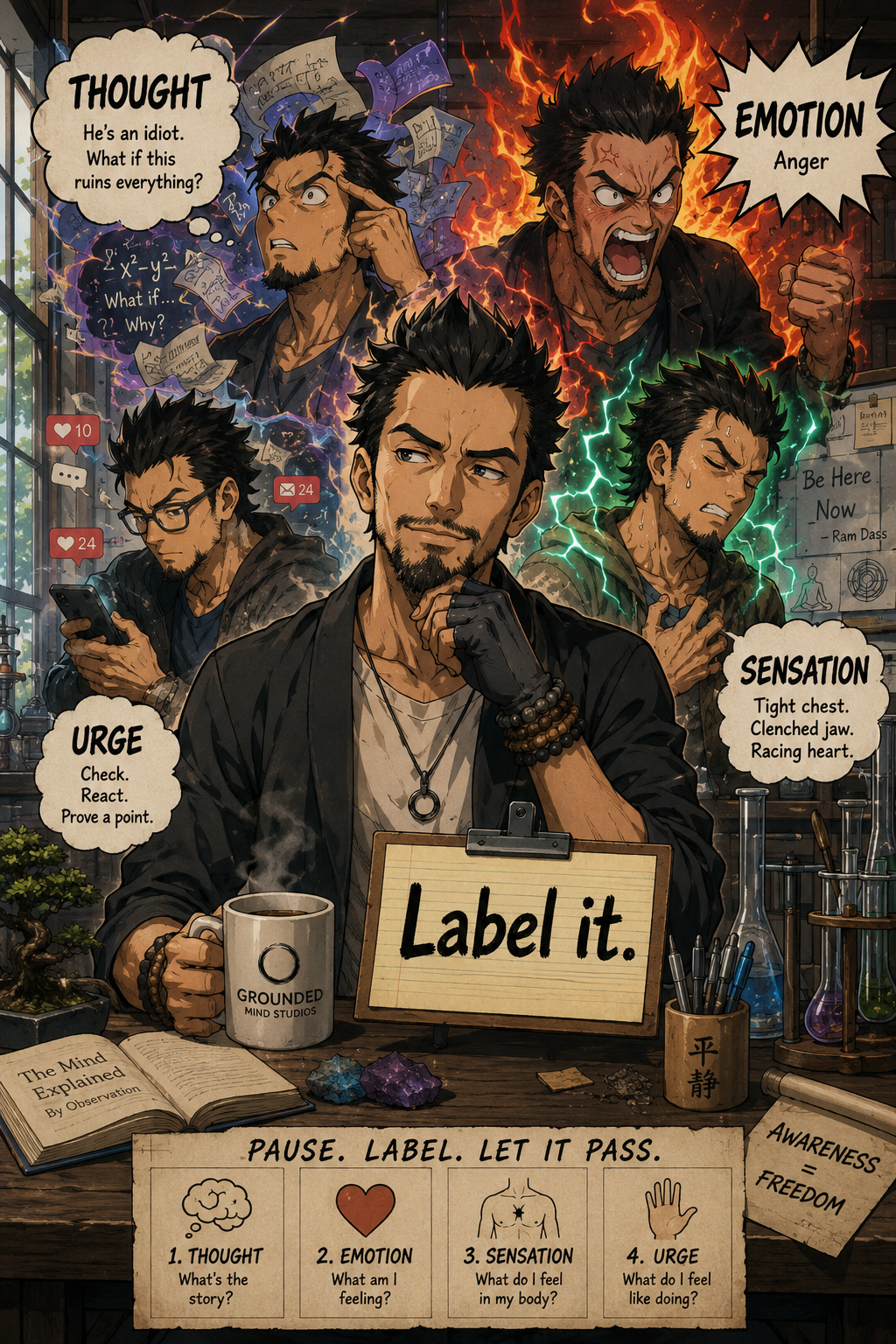
Pause. Label It. Breathe. Let It Pass.
Your brain has some wild suggestions sometimes.
Someone cuts you off in traffic.
A coworker says something that gets under your skin.
An email lands in your inbox and immediately makes your blood pressure feel like it has entered a different zip code.
Before you know it, your brain is writing an entire revenge movie.
This is where mindfulness becomes useful in everyday life.
Not because mindfulness makes you immune to anger, frustration, anxiety, or stress.
And not because you are supposed to pretend everything is fine when it is not.
Mindfulness gives us something much more practical:
A little space between what happens and what we do next.
You Do Not Have to React to Everything You Experience
When something triggers us, several things can happen almost simultaneously.
We have a thought.
We experience an emotion.
Our body reacts.
And before we have even recognized what is happening, we may already be responding to it.
Maybe your jaw tightens.
Your heart starts beating faster.
Your chest feels tight.
Then your brain jumps in with its incredibly helpful commentary:
Insert your favorite four-letter descriptive noun here.
The thought itself is not necessarily the problem.
Neither is the anger.
Neither is the tension in your body.
The important part is recognizing what is happening before those experiences automatically determine what you do next.
That is where a simple mindfulness practice can help.
Step 1: Pause
Before trying to fix anything, pause.
Even a few seconds can give you an opportunity to notice what is happening instead of immediately reacting to it.
You are not trying to make the feeling disappear.
You are simply interrupting the automatic sequence long enough to become aware of it.
Take a breath.
Then look at what is actually happening.
Step 2: Label It
Instead of simply saying, “I am pissed off,” get curious about the experience.
Separate it into pieces.
Thought: What is your brain saying?
“This person has absolutely no idea what they are doing.”
Or perhaps that colorful four-letter descriptive noun makes another appearance.
Emotion: What are you feeling?
Anger? Frustration? Embarrassment? Anxiety? Fear?
Sensation: What is happening in your body?
Tight chest.
Clenched jaw.
Warm face.
Racing heart.
Tense shoulders.
Butterflies in your stomach.
You are not trying to decide whether any of these experiences are good or bad.
You are simply identifying them.
Research into affect labeling, the practice of putting feelings into words, suggests that labeling emotional experiences can influence how the brain responds to them. In one neuroimaging study, researchers found that putting feelings into words was associated with reduced activity in the amygdala and increased activity in a region of the prefrontal cortex involved in regulation (Lieberman et al., 2007).
In other words, there may be something powerful about simply recognizing:
This is anger.
Instead of immediately becoming:
I AM ANGRY.
Step 3: Breathe
Once you have identified what is happening, bring your attention to your breath.
You do not need an elaborate breathing technique.
Take one slow, intentional breath.
Notice the inhale.
Notice the exhale.
Feel what happens in your body.
The purpose is not to magically erase the emotion. Your breath simply gives you something happening right now to bring your attention back to.
Step 4: Let It Pass
Thoughts change.
Emotions change.
Physical sensations change.
You do not have to chase them away.
You also do not have to build a house for them and invite them to stay all afternoon.
Notice what is there and allow the experience to change on its own.
Mindfulness-based approaches often teach people to observe thoughts and emotions as temporary mental events rather than automatically treating them as facts or commands.
That distinction matters.
Your brain can submit all the suggestions it wants.
You are under no obligation to approve them.
This Is What Mindfulness Can Look Like
Mindfulness does not always look like sitting peacefully with your eyes closed.
Sometimes mindfulness happens in traffic.
Sometimes it happens during an argument.
Sometimes it happens five seconds after opening an email.
Sometimes it happens when you realize that the sentence currently forming in your head probably does not need to become the sentence coming out of your mouth.
That moment of awareness matters.
You noticed.
You paused.
Now you have a choice.
That is the practice.
Try It Today
The next time you notice yourself getting worked up, try this:
PAUSE
Stop for a moment before reacting.
LABEL
What is happening?
Thought
Emotion
Physical sensation
BREATHE
Take one slow, intentional breath.
LET IT PASS
You do not have to fight the experience or immediately act on it.
Just notice what happens next.
You may still decide that something needs to be said.
You may still need to set a boundary.
You may still be angry.
Mindfulness is not about becoming passive.
It is about making sure you are choosing your response instead of allowing the reaction to choose for you.
Pause. Label it. Breathe. Let it pass.
References
Lieberman, M. D., Eisenberger, N. I., Crockett, M. J., Tom, S. M., Pfeifer, J. H., & Way, B. M. (2007). Putting Feelings Into Words: Affect Labeling Disrupts Amygdala Activity in Response to Affective Stimuli. Psychological Science, 18(5), 421–428.
Kabat-Zinn, J. (1990). Full Catastrophe Living. Delacorte Press.
Hayes, S. C., Strosahl, K. D., & Wilson, K. G. (2016). Acceptance and Commitment Therapy: The Process and Practice of Mindful Change (2nd ed.). Guilford Press.
Creswell, J. D. (2017). Mindfulness Interventions. Annual Review of Psychology, 68, 491–516.
Gu, J., Strauss, C., Bond, R., & Cavanagh, K. (2015). How Do Mindfulness-Based Cognitive Therapy and Mindfulness-Based Stress Reduction Improve Mental Health and Wellbeing? A Systematic Review and Meta-Analysis of Mediation Studies. Clinical Psychology Review, 37, 1–12.