
Morning Shower vs. Night Shower: Why Both Matter for Your Mind
Most of us step into the shower because we need to get clean.
What if it could also become one of the simplest mindfulness practices in your day?
For just a few minutes, the shower becomes one of the few places where the outside world cannot interrupt you. There are no emails to answer. No meetings. No notifications. Just warm water, steady breathing, and a chance to reset.
Interestingly, the purpose of that reset changes depending on when you shower.
The Morning Shower: Preparing for the World
A morning shower can become more than part of your routine.
It can become the moment you intentionally step into your day.
The warm water stimulates your senses, increases alertness, and creates a transition between sleep and action. Many people naturally begin organizing their thoughts while showering because the brain’s default mode network becomes active during repetitive, low-demand activities.
Instead of rushing through it, try asking yourself:
What matters most today?
Who do I want to be today?
What deserves my attention?
What can wait?
The shower becomes less about washing your body and more about setting your intention.
The Night Shower: Leaving the Day Behind
Even if your work never became physically dirty, your mind probably did.
Stress accumulates.
Arguments linger.
Deadlines echo.
Conversations replay.
A night shower creates a psychological boundary between your responsibilities and your recovery.
Research suggests that taking a warm shower one to two hours before bed can actually help improve sleep. As your body cools afterward, your brain recognizes the temperature drop as a cue that it is time to rest.
Whether or not you believe water “washes away energy,” there is undeniable value in creating a ritual that tells your nervous system:
Today is finished.
One practice I often recommend is imagining the water carrying away whatever no longer serves you.
Not because the water has magical properties.
Because your brain responds remarkably well to intentional rituals.
Ancient Traditions Understood This
Across cultures, water has symbolized renewal.
Ayurveda describes daily bathing as an act of cleansing and preparation.
Japanese Misogi uses flowing water as a practice of purification and presence.
Many spiritual traditions begin ceremonies with washing because humans have long understood something modern psychology is beginning to appreciate:
Physical actions often change mental states.
You do not have to believe every traditional explanation to appreciate the wisdom behind the practice.
Turn the Shower Into a Mindfulness Practice
Tomorrow morning, instead of planning your grocery list, try this:
Take three slow breaths.
Feel the warmth of the water.
Notice where you are holding tension.
Choose one intention for the day.
Then, tonight…
Stand under the water for thirty extra seconds.
Imagine the stress, frustration, mistakes, and expectations flowing down the drain.
Leave them there.
Tomorrow deserves a version of you that is rested, not still carrying yesterday.
The Bottom Line
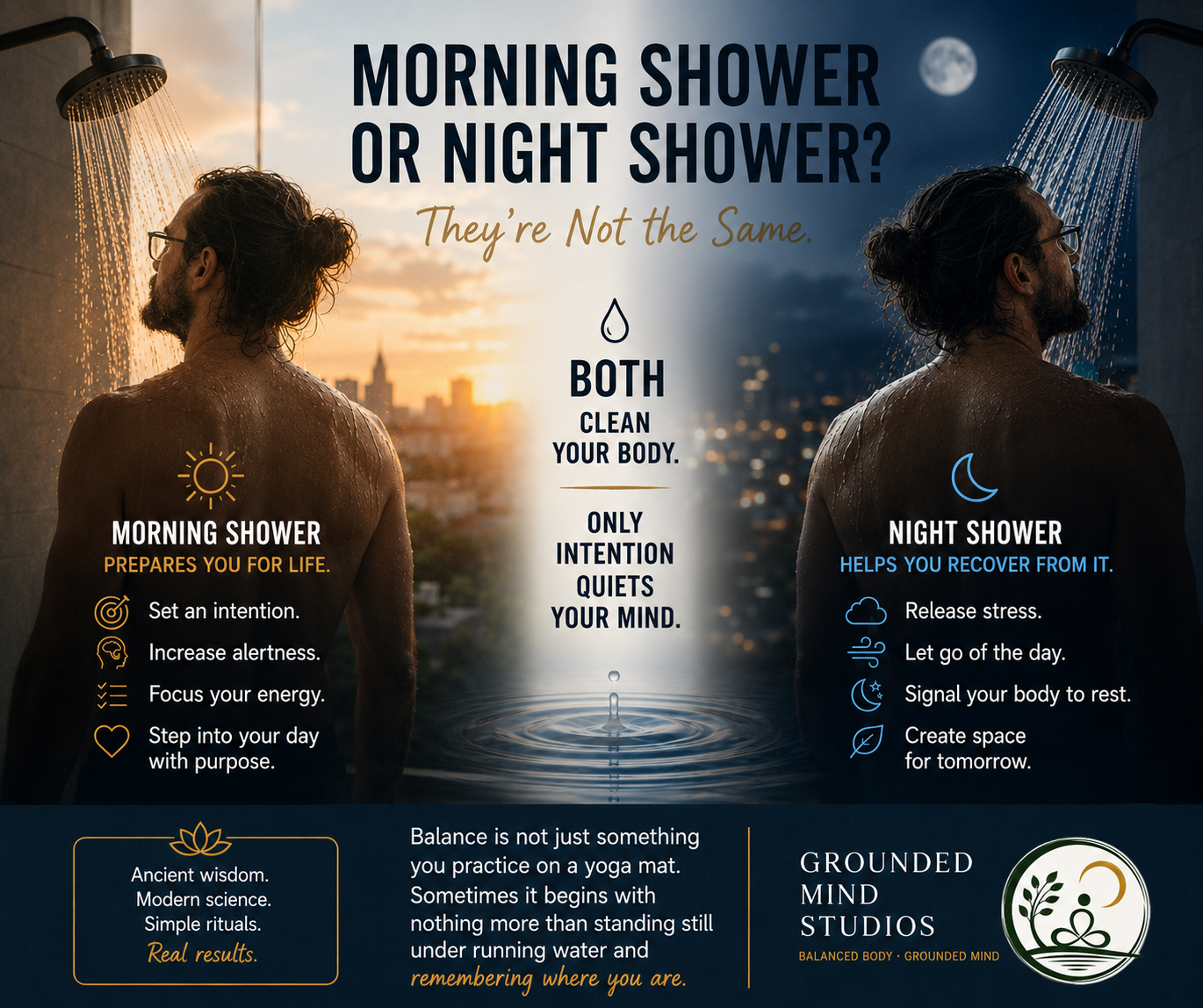
Morning showers prepare you for life.
Night showers help you recover from it.
Both clean your body.
Only intention cleans your mind.
Balance is not just something you practice on a yoga mat. Sometimes it begins with nothing more than standing still under running water and remembering where you are.
References
American Academy of Sleep Medicine. (n.d.). Healthy sleep habits. https://sleepeducation.org
Averbuch, I. (1995). The gods come dancing: A study of the Japanese ritual dance of Yamabushi Kagura. Cornell East Asia Series.
Duhigg, C. (2012). The power of habit: Why we do what we do in life and business. Random House.
Haghayegh, S., Khoshnevis, S., Smolensky, M. H., Diller, K. R., & Castriotta, R. J. (2019). Before-bedtime passive body heating by warm shower or bath to improve sleep: A systematic review and meta-analysis. Sleep Medicine Reviews, 46, 124-135. https://doi.org/10.1016/j.smrv.2019.04.008
Kabat-Zinn, J. (1994). Wherever you go, there you are: Mindfulness meditation in everyday life. Hyperion.
Lad, V. (2002). Textbook of Ayurveda: Fundamental principles. The Ayurvedic Press.
National Sleep Foundation. (n.d.). How a warm bath or shower before bed helps you sleep. https://www.sleepfoundation.org
Raichle, M. E. (2015). The brain’s default mode network. Annual Review of Neuroscience, 38, 433-447. https://doi.org/10.1146/annurev-neuro-071013-014030
World Health Organization. (2022). Mental health: Stress. https://www.who.int/news-room/fact-sheets/detail/mental-disorders
Author’s Note: This article combines findings from sleep science and psychology with historical mindfulness traditions. References to Ayurveda and Misogi are included to provide cultural and historical context and are not presented as scientific evidence for spiritual claims. The mindfulness practices described are intended to support stress management and self-reflection rather than diagnose, treat, or prevent medical conditions.