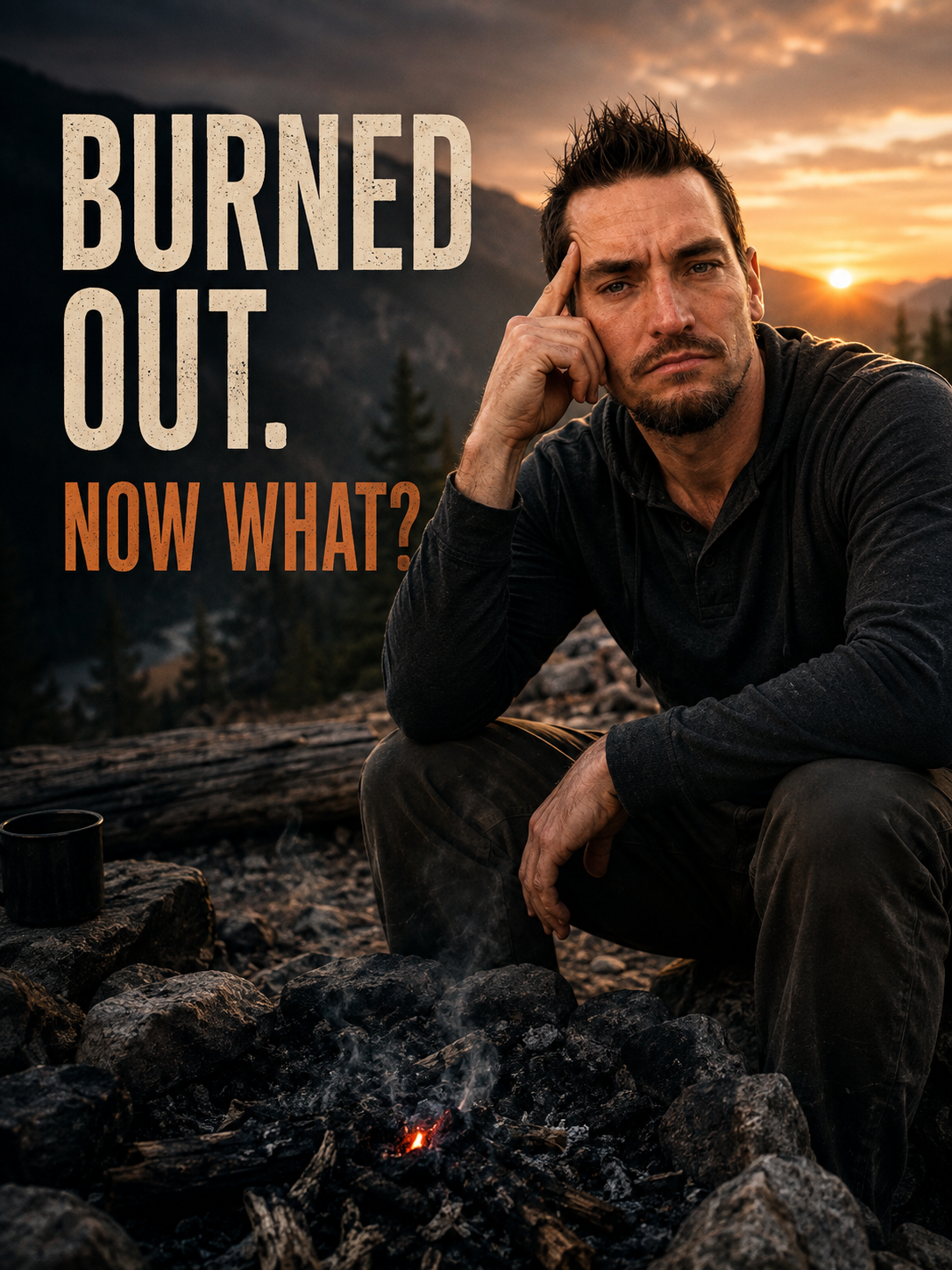
Burned Out. Now What?
There are thousands of articles about how to prevent burnout.
Set boundaries.
Get enough sleep.
Take breaks.
Exercise.
Learn to say no.
All good advice.
But what happens when you are already burned out?
What happens when you have been working toward something you genuinely care about and things simply are not going your way?
The opportunities you thought were coming disappear.
Plans fall apart.
The results do not match the amount of work you have been putting in.
Eventually, you wake up one morning and realize the fire that got you started feels a whole lot more like a pilot light.
That does not necessarily mean it is time to quit.
Sometimes you need to figure out how to reignite it.
Burnout Is More Than Having a Bad Week
The World Health Organization describes burnout as an occupational phenomenon resulting from chronic workplace stress that has not been successfully managed. It is characterized by exhaustion, increased mental distance or cynicism toward work, and reduced professional efficacy.
That last part matters.
Burnout does not only leave you tired.
It can change how you feel about the work itself.
Something you once felt passionate about can suddenly feel like something you would rather avoid.
And that can make it very difficult to tell the difference between needing to change your direction and simply needing to recover.
Burnout Can Make Everything Look Like a Dead End
One of the hardest parts about burnout is how differently the road ahead can start to look.
Things that once felt exciting become exhausting.
Small setbacks feel enormous.
Decisions become harder.
Eventually the question changes from:
“How do I make this work?”
to:
“Do I even want to do this anymore?”
That is not always a question that needs to be answered immediately.
When you are exhausted, frustrated, disappointed, or worried about money, there may be several different problems happening at the same time.
Sometimes the first thing you need is not another strategy.
It is enough space to figure out what you are actually experiencing.
Do Not Confuse Exhaustion With Losing Your Purpose
There is an important difference between:
I do not want this anymore.
and
I do not want to keep feeling like this.
Those can feel remarkably similar when you are exhausted and discouraged.
So before abandoning something that once mattered deeply to you, pause long enough to ask yourself:
If the pressure disappeared tomorrow, would I still want this?
If the answer is no, maybe something really has changed.
But if the answer is yes, the dream may not be the problem.
You may simply be exhausted from trying to carry it.
Stop Trying to Reignite the Entire Fire
When motivation disappears, our instinct is often to force it back.
New plan.
New routine.
New goals.
New productivity system.
Monday morning comes and suddenly we are going to completely reinvent our lives.
That usually lasts until Tuesday.
Instead of trying to rebuild the entire fire, find one ember.
What is one part of what you are doing that still feels meaningful?
One person you enjoy helping.
One part of the work you still look forward to.
One idea that still gets you talking a little faster when you explain it.
Start there.
You do not need enough motivation for the next five years.
You need enough for the next step.
Research on recovery from burnout also suggests that regaining a sense of control and receiving support from other people can be important resources during recovery. Recovery is not necessarily about somehow manufacturing more motivation by yourself.
Give Yourself Permission to Change the Plan
There is another trap that comes with burnout:
Believing that changing direction means giving up.
It does not.
Sometimes persistence means continuing exactly as planned.
Sometimes persistence means admitting the original plan is not working and building another one.
Taking temporary work does not automatically mean abandoning a business.
Changing your business model does not mean the original idea failed.
Asking for help does not mean you were incapable of doing it yourself.
Slowing down does not mean you stopped moving forward.
The destination and the route are not the same thing.
Research on workplace burnout supports this broader view. High demands contribute to burnout, while resources such as autonomy, support, and opportunities for recovery are associated with greater engagement and well-being.
In other words, sometimes the answer is not “try harder.”
Sometimes something about the environment, workload, resources, or plan needs to change.
Remember Why You Started, Then Ask Why You Are Continuing
“Remember your why” has become one of those phrases repeated so often that it can lose its meaning.
But there is something valuable underneath it.
Go back to the beginning.
Why did this matter to you before anyone paid you?
Before the business plan.
Before the website.
Before the numbers.
Before anybody said yes or no.
What were you trying to create?
Who were you trying to help?
What did you want your life to look like?
Then ask a second question:
Does that still matter to me?
Your original reason for starting does not obligate you to continue forever.
But if that reason still lights something up inside you, even faintly, pay attention to it.
There may still be an ember there.
You Are Allowed to Be Discouraged
Mindfulness does not require pretending everything is wonderful.
You can be disappointed.
You can be angry.
You can be scared.
You can question whether something is working.
You can even spend a day wanting absolutely nothing to do with the thing you normally love.
The practice is noticing those feelings without immediately turning them into permanent conclusions.
“I feel defeated today” is very different from “I am defeated.”
One describes what you are experiencing.
The other turns a temporary experience into an identity.
Recovery Is Part of the Work
Research on recovery from work has identified experiences such as psychological detachment, relaxation, a sense of control, and engaging in activities that provide challenge or mastery as important parts of recovering depleted resources.
That does not necessarily mean taking a two-week vacation and disappearing from your responsibilities.
Recovery can happen in smaller ways.
Take an evening when you are genuinely not working.
Go somewhere that reminds you there is a world outside your business or career.
Move your body.
Make something.
Spend time with someone who has absolutely nothing to do with your work.
Do something you are good at simply because you enjoy being good at it.
Give your brain an opportunity to experience something other than the problem you have been trying to solve.
Stepping away is not always quitting.
Sometimes stepping away is how you regain enough energy and perspective to come back.
Maybe You Do Not Need More Motivation
Sometimes motivation is not the problem.
Sometimes you need rest.
Sometimes you need money.
Sometimes you need help.
Sometimes you need a different strategy.
Sometimes you need more resources.
Sometimes you need one damn thing to finally go right.
And sometimes you need to admit that you are disappointed before you can figure out what comes next.
You do not have to manufacture enthusiasm you do not currently feel.
Start smaller.
Pause.
Take inventory.
Find the ember.
Then decide what deserves your energy next.
Because burnout does not necessarily mean the fire is gone.
Sometimes it just means it needs fuel.
References
World Health Organization. Burn-out an “Occupational Phenomenon”: International Classification of Diseases. WHO. Burnout is described in ICD-11 as an occupational phenomenon associated with chronic workplace stress that has not been successfully managed.
Agolli, A., & Holtz, B. C. (2023). Facilitating Detachment From Work: A Systematic Review, Evidence-Based Recommendations, and Guide for Future Research. Journal of Occupational Health Psychology, 28(3), 129–159.
Bennett, A. A., Gabriel, A. S., Calderwood, C., Dahling, J. J., & Trougakos, J. P. (2016). Better Together? Examining Profiles of Employee Recovery Experiences. Journal of Applied Psychology.
Mäkikangas, A., Kinnunen, U., Feldt, T., & Schaufeli, W. (2011). Identifying Patterns of Recovery Experiences and Their Links to Psychological Outcomes Across One Year. International Archives of Occupational and Environmental Health.
Salmela-Aro, K., et al. (2021). Seizing and Realizing the Opportunity: A Salutogenic Perspective on Rehabilitation After Burnout. Work, 68(4). Research examining experiences associated with successful rehabilitation after burnout.
Lesener, T., Gusy, B., & Wolter, C. (2019). The Job Demands-Resources Model: A Meta-Analytic Review of Longitudinal Studies. Work & Stress, 33(1), 76–103.
Bakker, A. B., & Demerouti, E. (2017). Job Demands-Resources Theory: Taking Stock and Looking Forward. Journal of Occupational Health Psychology, 22(3), 273–285.