
Five Things That Don’t Suck
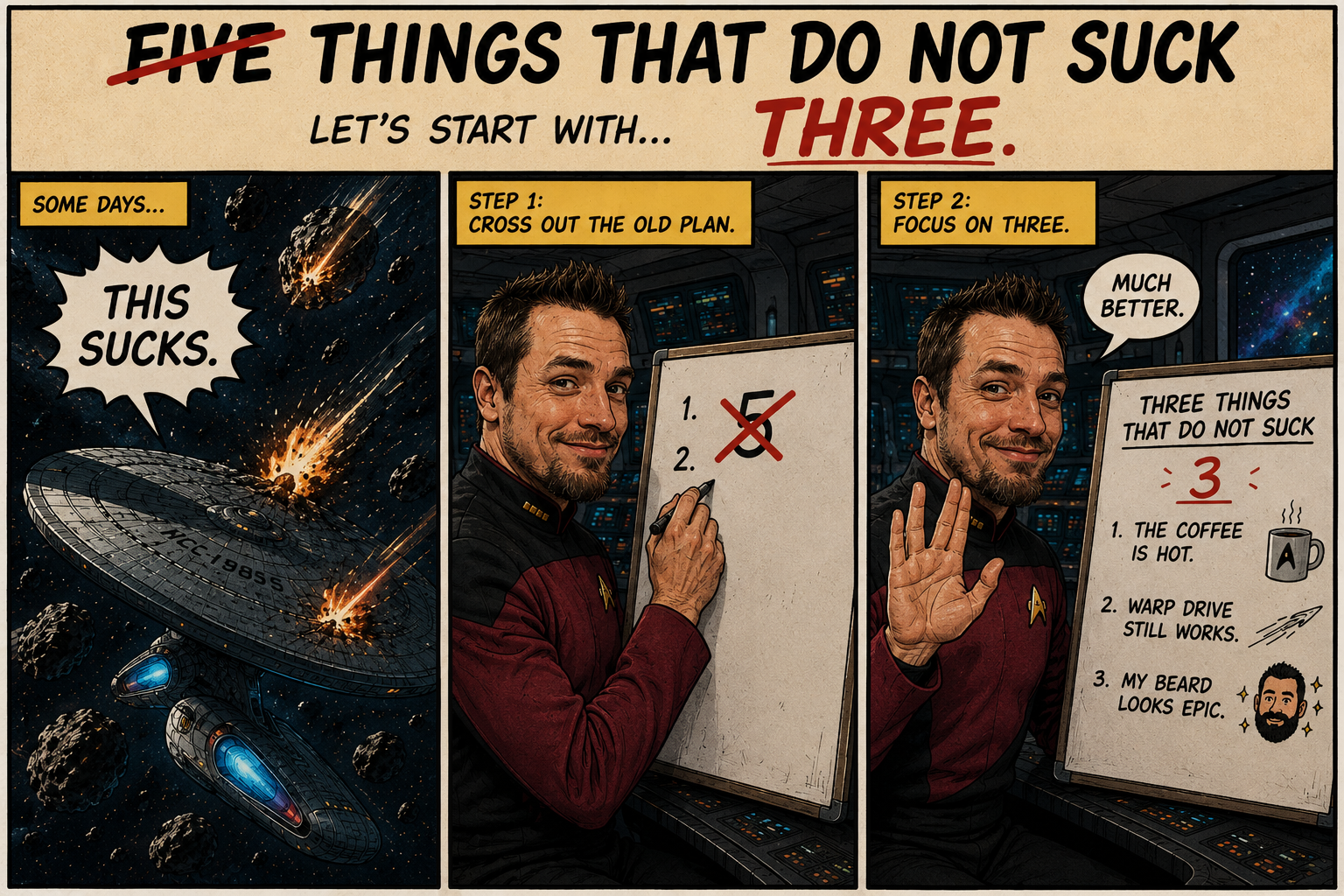
Some days everything sucks.
You wake up in a bad mood.
Something you have been working toward falls apart.
Money is tight.
Someone disappoints you.
You are exhausted.
And then somebody comes along and tells you:
“Just be grateful for what you have.”
Thanks.
Very helpful.
When you are sad, discouraged, stressed, or simply having a shitty day, forcing yourself to suddenly feel grateful for your wonderful life can feel ridiculous.
That is not what this exercise is about.
You do not have to convince yourself that everything is great.
You are simply going to remind your brain that everything is not terrible either.
Your Attention Can Get Stuck
Have you ever had one thing go wrong in the morning and suddenly everything seems to piss you off?
Traffic sucks.
Your coffee sucks.
Someone sends you an annoying email.
Your phone will not stop ringing.
By lunchtime your brain has assembled enough evidence to confidently conclude:
Today sucks.
The frustrating part is that plenty of other things may have happened during that same morning.
You just were not paying much attention to them.
That is where gratitude can become a mindfulness practice.
Not as a way of denying what is wrong.
As a way of intentionally noticing what else is happening.
Research on gratitude interventions suggests that intentionally practicing gratitude can produce modest improvements in well-being and positive emotions. A large 2025 meta-analysis involving more than 24,000 participants found small but reliable overall improvements in well-being following gratitude interventions.
A separate 2023 systematic review and meta-analysis of 64 randomized clinical trials found that gratitude interventions were associated with better mental-health outcomes, more positive mood and emotions, and fewer symptoms of anxiety and depression.
That does not mean gratitude makes your problems disappear.
It means deliberately directing attention toward something positive may help broaden the picture your brain is currently showing you.
Forget the Perfect Gratitude List
A traditional gratitude exercise might ask:
“What are you grateful for today?”
Some days that is easy.
Other days your brain responds:
Absolutely nothing. Leave me alone.
Fair enough.
So let us lower the bar.
Find five things that do not suck right now.
Actually…
Scratch that.
If you are already down, overwhelmed, or exhausted, five things might feel like homework.
Let us start with three.
And they do not need to be profound.
You do not need:
My incredible journey through this beautiful gift called life.
Give me a break.
We are looking for three ordinary things.
Maybe:
1. My coffee is hot.
2. This song still kicks ass.
3. I have clean socks.
Congratulations.
You just practiced gratitude.
And you did it without pretending everything else was wonderful.
The Three Things Exercise
When you notice yourself getting stuck in one of those moods where everything seems wrong, pause.
Look around.
Find three things that do not suck right now.
They can be things you see.
Things you hear.
Things you feel.
Someone you appreciate.
Something that made you laugh.
Something that tastes good.
Something your body can still do.
Something beautiful sitting ten feet away that you had not noticed because your brain was busy replaying everything that went wrong.
Write them down if you want.
Say them quietly to yourself.
Or just notice them.
And if three feels like too much today?
Find one.
This is not a test.
There is no perfect list.
The point is not completing the list. The point is noticing something else.
Do Not Fake It
There is another reason I like this version of gratitude practice.
You do not have to lie to yourself.
If something hurts, it hurts.
If you are disappointed, you are disappointed.
If today has genuinely been awful, you do not have to slap a motivational quote over it and pretend otherwise.
Mindfulness asks us to notice what is actually happening.
That includes the uncomfortable stuff.
But it also means noticing when our attention has become so consumed by what hurts that we stop seeing everything else.
You can be disappointed and enjoy your coffee.
You can be worried about money and appreciate the sunset.
You can be angry with someone and laugh at something stupid five minutes later.
Two things can be true at the same time.
Gratitude does not have to erase the difficult thing to make room for something good.
The Research Is Not Saying Gratitude Fixes Everything
This part matters.
Gratitude practice is not therapy.
It is not a treatment for every mental-health condition.
And nobody struggling with depression needs another person telling them they should simply “be more grateful.”
Research is more nuanced than that.
A systematic review specifically examining gratitude interventions among workers found encouraging improvements in perceived stress and depressive symptoms in several studies, but results for overall well-being were inconsistent.
Other research has found that the type of gratitude practice matters.
So this is not a prescription.
It is a tool.
And like every mindfulness tool, sometimes it will help more than others.
You Are Not Trying to Become Happy
That is probably the most important part of this exercise.
The goal is not:
Sad → three things → HAPPY!
Human beings do not work like that.
The goal is awareness.
Maybe before the exercise your attention was giving 100% of its airtime to everything going wrong.
Afterward, perhaps there is still sadness.
There is still frustration.
There is still uncertainty.
But now there is also:
Hot coffee.
A good song.
Clean socks.
Your problems did not disappear.
You simply reminded your brain that what hurts is not the only thing happening.
And sometimes that tiny shift is enough to help you take the next step.
Try It Right Now
Do not wait until tomorrow morning.
Look around wherever you are.
Find five things that do not suck.
Actually, no.
We already established that sounds like work.
Find three.
Not three blessings.
Not three profound reasons your life is wonderful.
Just three things that do not suck.
And if today genuinely sucks so much that three feels impossible?
Find one.
That is still a start.
References
Diniz, G., Korkes, L., Tristão, L. S., Pelegrini, R., Bellodi, P. L., & Bernardo, W. M. (2023). The Effects of Gratitude Interventions: A Systematic Review and Meta-Analysis. Einstein (São Paulo), 21, eRW0371.
Shin, L. J., et al. (2025). A Meta-Analysis of the Effectiveness of Gratitude Interventions on Well-Being Across Cultures. Meta-analysis of 145 papers, 163 samples, and 24,804 participants across 28 countries.
Komase, Y., Watanabe, K., Hori, D., Nozawa, K., Hidaka, Y., Iida, M., Imamura, K., & Kawakami, N. (2021). Effects of Gratitude Intervention on Mental Health and Well-Being Among Workers: A Systematic Review. Journal of Occupational Health, 63(1), e12290.
Dickens, L. R. (2017). Using Gratitude to Promote Positive Change: A Series of Meta-Analyses Investigating the Effectiveness of Gratitude Interventions. Basic and Applied Social Psychology, 39(4), 193–208.
Davis, D. E., et al. (2016). Thankful for the Little Things: A Meta-Analysis of Gratitude Interventions. Journal of Counseling Psychology, 63(1), 20–31.
Emmons, R. A., & McCullough, M. E. (2003). Counting Blessings Versus Burdens: An Experimental Investigation of Gratitude and Subjective Well-Being in Daily Life. Journal of Personality and Social Psychology, 84(2), 377–389.