
It is OK to Hate Where Things Are Right Now
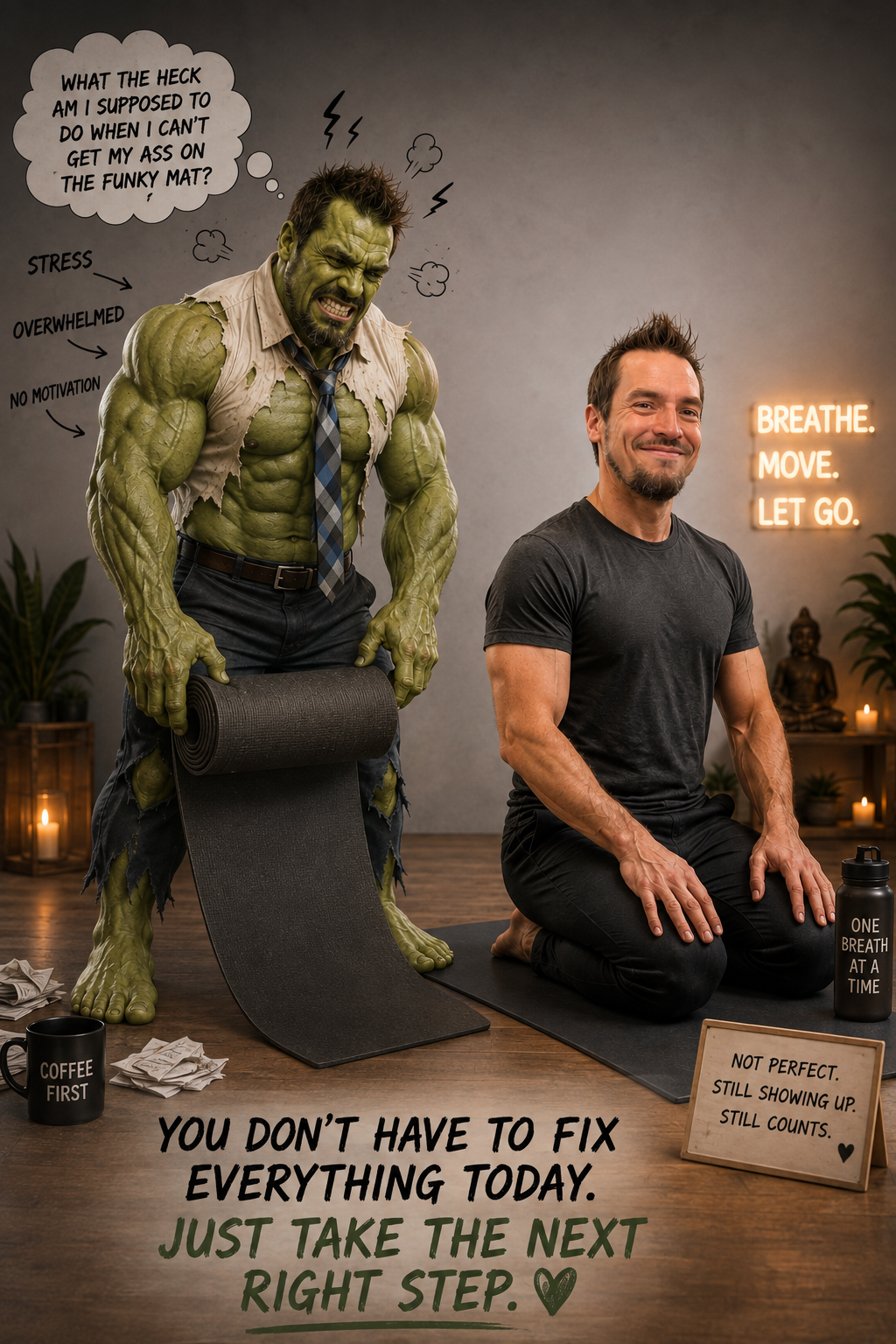
It is OK to hate where things are right now without having to fix it all right now.
Some days suck.
Not because you are looking at them wrong.
Not because you forgot to practice gratitude.
Not because you need a better morning routine, another inspirational quote, or somebody telling you to “think positive.”
Sometimes things genuinely are not going the way you wanted them to.
Something falls apart.
Someone lets you down.
Money gets tight.
The plan that looked great a month ago suddenly looks impossible.
You are tired, frustrated, disappointed, and maybe a little pissed off at the entire situation.
And then we do something interesting.
We immediately try to fix it.
What do I need to change?
What should I do next?
How do I get motivated again?
How do I make this feeling go away?
How do I get my life back on track by approximately 3:00 this afternoon?
Maybe you do not.
At least not today.
Not Everything Needs an Immediate Solution
There is a difference between accepting where you are and deciding to stay there.
Acceptance is not:
“This is fine.”
Sometimes it absolutely is not fine.
Acceptance can simply be:
“This is where I am right now. I do not like it. But this is what I am experiencing.”
There is research behind this idea.
Studies examining what psychologists call habitual acceptance have found that people who tend to accept their thoughts and emotions without immediately judging them report better psychological well-being. Researchers have also found that acceptance is associated with experiencing less negative emotion in response to everyday stressors.
That does not mean accepting every circumstance in your life.
In fact, the researchers specifically distinguished accepting your internal experience from accepting the situation itself.
That distinction matters.
You can say:
“I hate this situation.”
while also saying:
“I am going to allow myself to feel disappointed about it without fighting myself for feeling disappointed.”
You do not have to add another problem by getting angry at yourself for being angry.
You Do Not Have to Turn Every Bad Day Into a Breakthrough
We love turning struggle into a story.
Something terrible happens and immediately we want to know:
What is the lesson?
How will this make me stronger?
What am I supposed to learn from this?
Maybe there will be a lesson.
Maybe six months from now you will look backward and understand exactly why something happened.
But maybe today?
It just sucks.
You are allowed to leave it there for a minute.
Mindfulness is not about replacing every uncomfortable thought with a comfortable one.
Sometimes the practice is simply noticing:
I am frustrated.
I am disappointed.
I am scared.
I am exhausted.
And then not immediately building an entire future around how you feel in this particular moment.
“I hate where things are right now” is very different from:
“My life is always going to be like this.”
One describes the present.
The other predicts a future you cannot possibly know.
Okay… But Eventually I Have to Get Off the Couch
This is where things get difficult.
Because acceptance can become a really convenient excuse to do absolutely nothing.
At some point, we probably do need to move.
And I know one of the things that helps me.
Yoga the funk out.
Move.
Breathe.
Get onto the mat.
Get out of my head and back into my body.
And there is research supporting yoga as a useful tool for stress. A 2024 meta-analysis of 36 studies found a moderate overall effect of yoga on perceived stress. Another systematic review of randomized trials in stressed adults found evidence of short-term reductions in perceived stress, although the authors rated that evidence as low quality.
Other systematic reviews have also found encouraging results for yoga and depressive symptoms, although the strength and consistency of the evidence varies depending on what yoga is compared against and which population is being studied.
So yes.
I know yoga can help.
There is just one small problem.
What the Heck Do I Do When I Cannot Get My Ass Onto the Funky Mat?
This might be the most important part.
Knowing what helps and actually doing it are two completely different things.
You can know that movement helps.
You can own the yoga mat.
You can literally teach yoga.
The mat can be sitting ten feet away staring at you like:
“Well?”
And you still cannot make yourself do it.
So forget the workout.
Forget the 60-minute yoga practice.
Forget changing clothes.
Forget creating the perfect environment.
Forget doing the entire thing.
Make the mat smaller.
Behavioral activation offers an interesting lesson here. Rather than requiring motivation to appear before action begins, behavioral activation deliberately schedules or increases meaningful and rewarding activities. It has substantial research behind it as a psychological treatment, including evidence that even self-guided approaches can have benefits.
I am not suggesting we turn that clinical treatment into a DIY therapy session.
I am stealing one very useful idea from it:
You do not necessarily have to feel motivated before you move.
So instead of:
“I need to do yoga.”
Try:
“I need to stand on the mat.”
That is it.
No commitment to practice.
Stand there.
If that is too much:
Sit on the mat.
Still too much?
Put the mat beside the couch.
Seriously.
Your next step could be ridiculously small.
Roll out the mat.
Sit on it.
Take one breath.
Stretch your arms overhead.
Do one cat-cow.
Stand in Mountain Pose.
Put on one song and move until it ends.
Take Child’s Pose and stay there.
Or lie flat on your back and do absolutely nothing for five minutes.
Congratulations.
You got on the funky mat.
Lower the Damn Bar
Sometimes we make getting ourselves out of a funk harder because we think the action has to be impressive enough to count.
It does not.
If your normal yoga practice is an hour and today you manage five minutes?
It counts.
If your normal workout is intense and today you walk around the block?
It counts.
If you normally journal three pages and today you write one sentence?
It counts.
If your big accomplishment today is showering, eating something, and answering one email?
Those things count too.
The goal is not to suddenly become the most productive version of yourself.
The goal is movement.
One tiny action gives you somewhere different to stand than you were standing five minutes ago.
And maybe nothing magical happens.
Maybe you still feel crappy afterward.
That is okay too.
You moved.
Maybe Motivation Comes Second
We tend to imagine motivation like this:
Feel better → Get motivated → Do something.
But sometimes the order has to be:
Do something tiny → Notice what happens → Maybe do something else.
That is part of what makes behavioral activation interesting. It does not require someone to wait around for motivation before beginning meaningful activity.
And I think that translates beautifully into mindfulness.
Do not demand that tomorrow’s version of you show up today.
Ask what today’s version can actually handle.
Maybe today that is a full yoga practice.
Awesome.
Maybe it is ten minutes.
Maybe it is one Sun Salutation.
Maybe you roll out the mat, lie there, stare at the ceiling and wonder how your life got so weird.
Still counts.
You showed up.
Today Does Not Need to Fix Tomorrow
You can hate where things are right now.
You can wish circumstances were different.
You can be disappointed with how something turned out.
And you can still decide that you are not solving your entire life today.
Pause.
Notice what you are feeling.
Stop fighting yourself for feeling it.
Then, when you are ready, make the next action almost embarrassingly small.
Not:
Fix my life.
Maybe:
Roll out the mat.
Not:
Get motivated again.
Maybe:
Take one breath.
Not:
Figure out the next five years.
Maybe:
Figure out the next five minutes.
You do not have to turn every bad day into a breakthrough.
Sometimes the mindful thing is simply recognizing:
This is where I am today.
I do not like it.
And I do not have to solve my entire life before I go to bed tonight.
Tomorrow can have tomorrow’s problems.
For now?
Maybe just get your ass onto the funky mat.
Even if all you do once you get there is lie down.
References
Ford, B. Q., Lam, P., John, O. P., & Mauss, I. B. (2018). The Psychological Health Benefits of Accepting Negative Emotions and Thoughts: Laboratory, Diary, and Longitudinal Evidence. Journal of Personality and Social Psychology, 115(6), 1075–1092.
Cuijpers, P., et al. (2026). Behavioral Activation for Depression: A Comprehensive Systematic Review and Meta-Analysis. Clinical Psychology Review. The review included 105 trials and 13,933 participants.
Kanter, J. W., et al. (2010). What Is Behavioral Activation? A Review of the Empirical Literature. Clinical Psychology Review, 30(6), 608–620.
Breedvelt, J. J. F., et al. (2024). Yoga as an Intervention for Stress: A Meta-Analysis. The analysis included 36 studies and found a moderate overall effect on perceived stress.
Cramer, H., et al. (2024). Effects of Yoga on Stress in Stressed Adults: A Systematic Review and Meta-Analysis. The review included 13 randomized controlled trials involving 1,026 participants.
Moosburner, A., Cramer, H., Bilc, M., Triana, J., & Anheyer, D. (2024). Yoga for Depressive Disorder: A Systematic Review and Meta-Analysis. Twenty-four studies involving 1,395 participants were included; evidence quality ranged from moderate to very low.