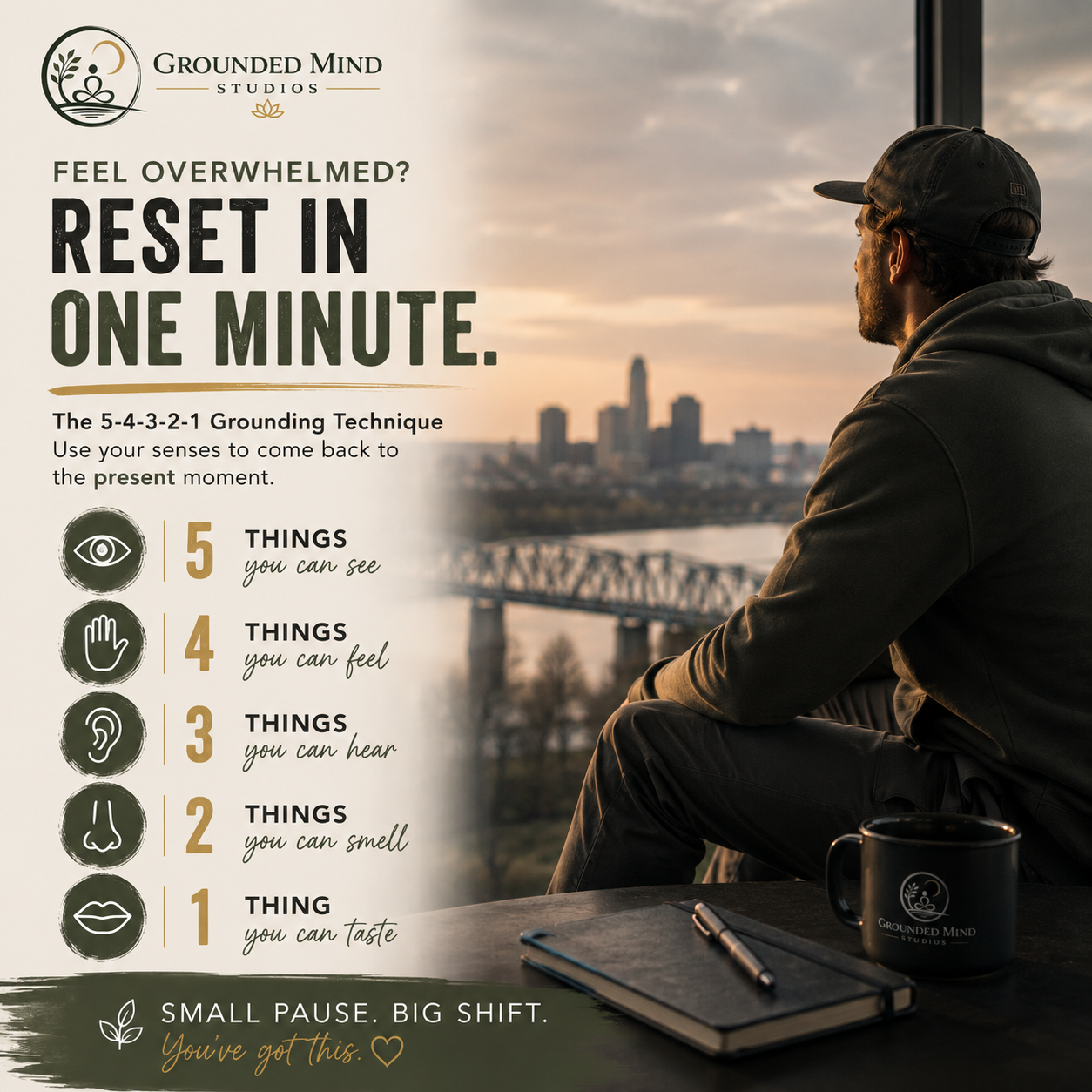
The 5-4-3-2-1 Grounding Technique
Have you ever noticed your mind racing so quickly that it feels impossible to slow down?
Maybe you are replaying a difficult conversation, worrying about tomorrow’s responsibilities, or feeling overwhelmed by everything on your to-do list.
When this happens, your attention is often pulled away from the present moment and into thoughts about the past or the future.
One of the simplest ways to interrupt this cycle is through a mindfulness exercise known as the 5-4-3-2-1 Grounding Technique.
This practice uses your five senses to gently bring your awareness back to the present—helping your mind and body feel more connected, calm, and grounded.
Why Grounding Works
When we experience stress, our attention often becomes consumed by racing thoughts.
Grounding exercises help shift our focus away from those thoughts and back toward our immediate surroundings.
Rather than trying to “stop thinking,” you simply become curious about what is happening right now.
This small shift can help reduce feelings of overwhelm and support a calmer, more balanced nervous system.
How to Practice the 5-4-3-2-1 Technique
The next time you notice yourself feeling anxious, overwhelmed, or mentally scattered, pause and slowly work through these five steps.
5 – Notice Five Things You Can See
Look around you.
Notice five things you may not have paid attention to before.
It could be sunlight coming through a window, the texture of a table, leaves moving in the breeze, or the color of the sky.
Take your time.
4 – Notice Four Things You Can Feel
Bring your attention to physical sensations.
Feel your feet on the floor.
Notice your clothing against your skin.
Feel the chair supporting your body or the warmth of your coffee mug.
Allow yourself to reconnect with your body.
3 – Notice Three Things You Can Hear
Pause and simply listen.
Maybe you hear birds outside.
The hum of the air conditioner.
Traffic in the distance.
Or your own breathing.
There is no need to judge the sounds—just notice them.
2 – Notice Two Things You Can Smell
Take a slow breath.
Can you smell fresh air?
Coffee?
Rain?
Even if no obvious scent is present, simply paying attention to your sense of smell helps anchor you in the present.
1 – Notice One Thing You Can Taste
Take a sip of water or simply notice the taste already present in your mouth.
It may seem like a small step, but it completes the exercise by engaging every one of your senses.
When to Use This Technique
The beauty of the 5-4-3-2-1 Grounding Technique is that it can be practiced almost anywhere.
Try it:
Before an important meeting
While sitting in traffic
During a stressful day at work
Before responding to a difficult email
Before going to sleep
Anytime you notice your mind beginning to spiral
The more often you practice during everyday moments, the more natural it becomes during life’s bigger challenges.
Mindfulness Is About Returning to the Present
Many people believe mindfulness means clearing the mind of all thoughts.
In reality, mindfulness is about noticing when your attention has wandered—and gently bringing it back.
Again and again.
There is no perfect way to practice.
Every time you return to the present moment, you strengthen your ability to respond to life with greater awareness instead of reacting automatically.
Final Thoughts
The next time life feels overwhelming, remember that you do not have to solve every problem all at once.
Sometimes your next step is simply to notice what is already around you.
Five things you can see.
Four things you can feel.
Three things you can hear.
Two things you can smell.
One thing you can taste.
One mindful moment can change the direction of your day.
Ready to Feel More Grounded?
At Grounded Mind Studios, we believe mindfulness should be simple, practical, and something you can use every day—not just during a yoga class.
Through mindfulness coaching, yoga, workshops, and corporate wellness programs, we help individuals and organizations develop practical tools for managing stress, improving focus, and building resilience.
If you are ready to feel more present, more resilient, and more grounded, we would love to help.
Visit GroundedMindStudios.com to learn more about our upcoming classes, mindfulness coaching, and corporate wellness programs—or contact us today to begin your wellness journey.
References
National Center for Complementary and Integrative Health. Meditation and Mindfulness: Effectiveness and Safety.
American Psychological Association. Stress Effects on the Body.
Harvard Health Publishing. Mindfulness Meditation May Ease Anxiety and Stress.
National Institute of Mental Health. Caring for Your Mental Health.