The STOP Technique: A Simple Way to Respond Instead of React
Life moves quickly.
A difficult email lands in your inbox. Traffic slows to a crawl. A conversation takes an unexpected turn. Before you know it, your heart rate increases, your thoughts begin racing, and you’re reacting before you’ve had a chance to think.
Most of us have experienced moments like these.
The good news is that mindfulness does not require an hour of meditation or a complete change in your routine. Sometimes, all it takes is a brief pause.
One of the simplest and most effective mindfulness tools is the STOP Technique—a practical exercise you can use almost anywhere to interrupt your automatic stress response and create space for a more intentional choice.
Why We React Automatically
Our brains are designed to protect us.
When we perceive a threat—whether it is a looming deadline, a disagreement, or an unexpected challenge—our nervous system prepares us to act quickly. This “fight or flight” response is incredibly useful during real danger, but it is not always helpful in everyday situations.
The problem is that our brains often respond to modern stressors as though they are emergencies.
That is where mindfulness comes in.
Mindfulness helps us pause long enough to recognize what is happening before our emotions take over.
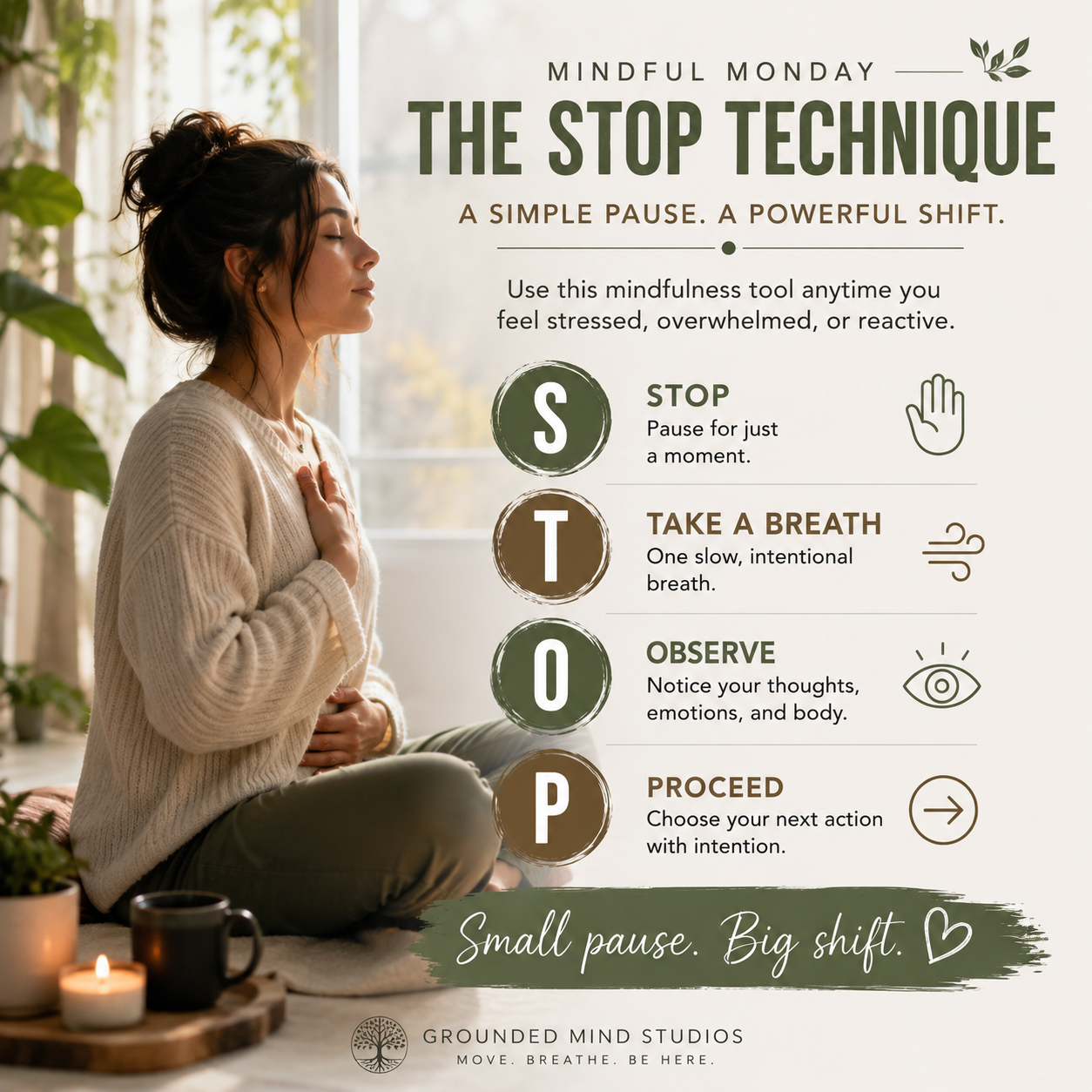
The STOP Technique
The STOP Technique is easy to remember and only takes a few moments.
S — Stop
Pause.
Do not send the email.
Do not react immediately.
Simply interrupt the momentum for a moment.
Even a five-second pause can help break the cycle of automatic reactions.
T — Take a Breath
Take one slow, intentional breath.
Breathe in through your nose.
Exhale slowly and completely.
Your breath is one of the fastest ways to communicate safety to your nervous system. A single mindful breath can begin shifting your body from a state of stress toward a calmer, more balanced state.
O — Observe
Become curious.
Ask yourself:
What am I thinking right now?
What emotions am I feeling?
Where am I holding tension in my body?
What is happening around me?
The goal is not to judge your experience. It is simply to notice it.
Awareness creates options.
P — Proceed
Now choose your next action intentionally.
Sometimes you will respond.
Sometimes you will wait.
Sometimes you will realize that no response is needed at all.
Mindfulness is not about suppressing emotions—it is about responding with intention instead of reacting on impulse.
When to Use the STOP Technique
This practice can be helpful in almost any situation, including:
Before responding to a difficult email
During a stressful workday
Before an important meeting
In the middle of an argument
While sitting in traffic
Before making an important decision
Anytime you feel overwhelmed or emotionally reactive
The more you practice during everyday moments, the easier it becomes to access when life becomes more challenging.
Small Pauses Create Big Changes
Many people believe mindfulness requires large blocks of uninterrupted time.
In reality, lasting change is often built through small, consistent moments of awareness.
One mindful breath.
One intentional pause.
One thoughtful response.
Those moments add up.
Over time, they can improve communication, reduce stress, strengthen relationships, and help you navigate life’s challenges with greater clarity and resilience.
Final Thoughts
Mindfulness is not about having a perfectly calm mind.
It is about learning to recognize when your mind has become overwhelmed and giving yourself the opportunity to choose your next step with intention.
The next time life feels overwhelming, remember four simple letters:
STOP.
Pause.
Take a breath.
Observe.
Proceed.
You may be surprised how much can change in just a few seconds.
Ready to Practice Mindfulness in Everyday Life?
At Grounded Mind Studios, we believe mindfulness should be practical, approachable, and something you can use beyond the yoga mat.
Through mindfulness coaching, yoga, workshops, and corporate wellness programs, we help individuals and organizations develop real-world skills for managing stress, improving focus, and building resilience.
If you’re ready to move from reacting to responding, we’d love to help.
Visit GroundedMindStudios.com to learn more about our upcoming classes, mindfulness coaching, and corporate wellness services—or contact us today to start your journey toward a more grounded life.
References
American Psychological Association. Stress Effects on the Body.
Harvard Health Publishing. Mindfulness Meditation May Ease Anxiety, Mental Stress.
National Center for Complementary and Integrative Health. Meditation and Mindfulness: Effectiveness and Safety.
National Institute of Mental Health. Caring for Your Mental Health.