
Tomorrow’s Agenda: Relax; Why Recovery Deserves a Place on Your Calendar
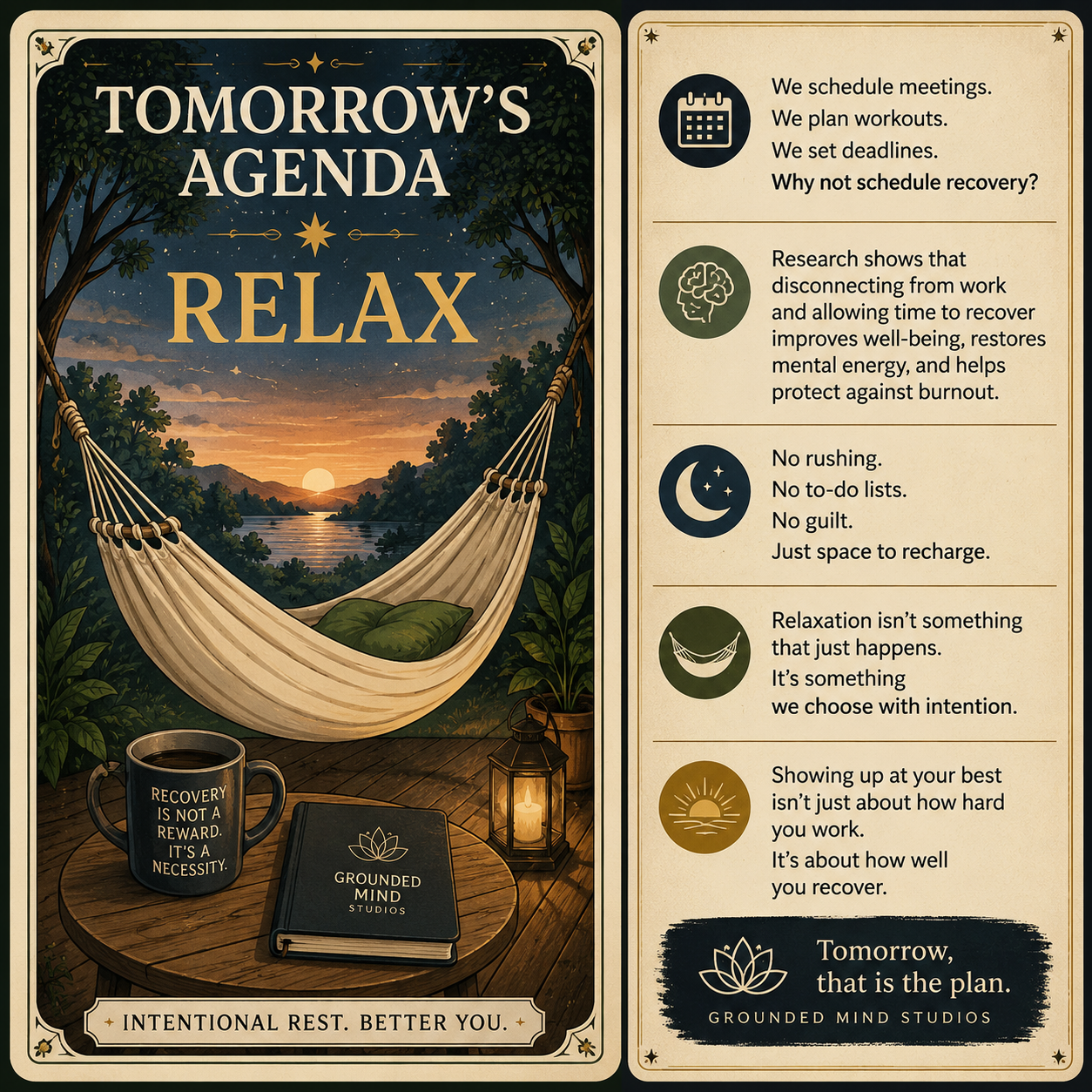
We schedule meetings.
We block time for workouts.
We fill our calendars with deadlines, appointments, and responsibilities.
But when was the last time you intentionally scheduled recovery?
For many of us, relaxation is treated as something we earn after everything else is finished. The problem is, everything else is rarely finished. There is always another email to answer, another project to complete, another obligation demanding our attention.
Eventually, we convince ourselves that slowing down is unproductive, or worse, something we should feel guilty about.
What if we have it backward?
Recovery Is Not an Accident
Most people do not accidentally recover.
They scroll through their phones. They watch television while thinking about work. They answer “just one more email.” Their body may stop moving, but their mind never really does.
True recovery is different.
It is intentional.
It is creating space where your mind and body are allowed to shift out of constant problem-solving and back into a state where they can recharge.
That might mean spending the afternoon in a hammock, taking a long walk without your phone, listening to live music, reading a book, or simply enjoying a quiet morning with nowhere to be.
The activity matters less than the intention behind it.
Why Recovery Matters
Stress itself is not the enemy.
Our bodies are remarkably capable of handling stress. In fact, short periods of stress can sharpen focus, improve performance, and help us adapt to challenges.
The problem arises when stress becomes constant and recovery never arrives.
Researchers studying workplace well-being have consistently found that psychologically disconnecting from work during evenings and weekends helps restore mental energy, improve mood, increase engagement, and reduce the risk of burnout. Recovery is not simply “taking time off.” It is an active process that replenishes the mental and emotional resources we spend throughout the week.
In other words, your ability to perform tomorrow depends on your willingness to recover today.
Recovery Is Productive
Many people view relaxation as the opposite of productivity.
It is not.
Recovery is part of productivity.
Professional athletes understand this. They train intensely, but they also prioritize sleep, nutrition, stretching, and recovery because they know performance suffers without it.
Our minds deserve the same treatment.
Whether you are leading a company, raising a family, managing a busy schedule, or simply trying to navigate everyday life, your ability to show up fully depends on more than how hard you work.
It also depends on how well you recover.
A Different Kind of Agenda
Imagine opening your calendar and seeing one simple item:
Relax.
No checklist.
No expectations.
No guilt.
Just permission to recharge.
It may feel uncomfortable at first, especially in a culture that celebrates being busy. But intentionally making space for recovery is not laziness; it is one of the healthiest investments you can make in your future self.
Tomorrow’s agenda does not always have to be about accomplishing more.
Sometimes the most important thing on your calendar is creating the energy to do your best work the next day.
Because showing up at your best is not just about how hard you work.
It is also about how well you recover.
References
Fritz, C., & Sonnentag, S. (2005). Recovery, Health, and Job Performance: Effects of Weekend Experiences. Journal of Occupational Health Psychology.
Sonnentag, S., & Fritz, C. (2015). Recovery from Job Stress: The Stressor-Detachment Model as an Integrative Framework. European Journal of Work and Organizational Psychology.